
On Gibraltar’s eastern shore, the future is taking shape in an unlikely form: breakwaters, workboats and reclaimed land. Between Eastern Beach and Catalan Bay, marine construction is under way beside a stretch of coast long associated with a huge mound of rubble. The finished district pictured in the developer’s drawings — apartment buildings, a luxury hotel and a marina — is still some way off.
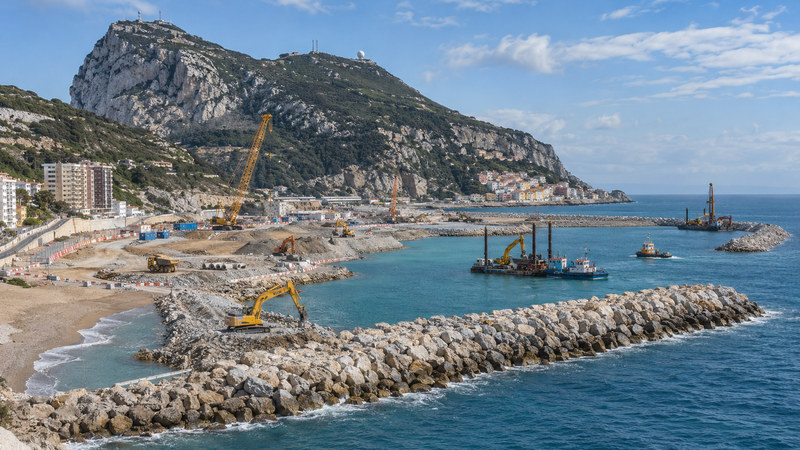
Eastside is no longer just an ambitious proposal, but neither is it a waterfront neighbourhood about to welcome its first visitors. As of November 2026, the engineering work is real. Most of the buildings remain a vision.
From a rubble tip to a new piece of Gibraltar
Gibraltar is accustomed to making the most of limited land. Much of its modern waterfront has been shaped by reclamation, and the pressure to accommodate homes, businesses and public spaces has hardly eased. The eastern coast, however, presents a different setting from the established marinas on the western side of the Rock.
Here, the Eastside scheme would transform the area between two well-known beaches into an entirely new mixed-use district. The proposal is being advanced by TNG Global, whose published masterplan puts the estimated development cost at £1.2 billion and describes an overall project scale of approximately 47.5 hectares.
The figure is striking, but it is a developer’s estimate of a proposed development, not evidence that £1.2 billion has already been spent or that every building has final approval.
What is planned for Eastside Marina?
At the heart of the scheme is a marina intended to accommodate both visiting superyachts and smaller local vessels. Around it, TNG envisages a new waterfront with restaurants, cafés, commercial premises, gardens and pedestrian routes. The current promotional plans also feature a five-star hotel of around 200 rooms, a conference facility and a maritime museum.
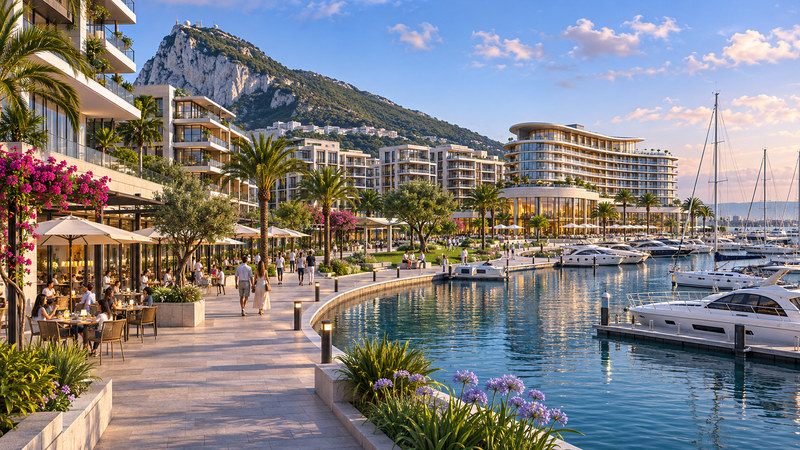
Housing accounts for a substantial part of the vision. TNG currently advertises approximately 2,200 high-end residential units, ranging from apartments to maisonettes and townhouses. There is also a proposed affordable-housing element, although the number of homes described in public statements has varied as the scheme has developed. The figure of 2,200 should therefore be read as the promoter’s current masterplan ambition, not as a confirmed count of completed or fully authorised apartments.
In the plans, pedestrian paths follow the Mediterranean and lead towards cafés and gardens. It would be a very different waterfront experience from Ocean Village, with its existing restaurants, hotels and berths on Gibraltar’s western side.
But renderings are not opening schedules. The shops, hotel and public spaces are proposed amenities, not facilities people can use today.
What has actually been approved and built?
The planning history helps explain why Eastside is moving forward in stages. Outline permission for the wider masterplan was granted in August 2022. In April 2025, Gibraltar’s Development and Planning Commission confirmed full planning permission for the coastal protection works and marina, which form the first construction phase, according to the Government of Gibraltar.
Work during 2026 has concentrated on marine reclamation and breakwaters. These structures are meant to protect the reclaimed land and establish the conditions for later development. They should not be confused with the construction or completion of the entire residential and hospitality complex.
In September 2026, planners conditionally authorised round-the-clock marine operations for the main breakwater. The decision did not extend unrestricted working to all parts of the site: the northern and southern breakwaters and noisier land-based activities remain subject to separate limits. The stated aim was to shorten the period of heavy marine works, with completion of the relevant marine-dumping programme projected for June 2027, rather than late August, if the revised schedule is achieved. GBC reported the planning decision and its safeguards.
June 2027 is therefore not a scheduled opening date for Eastside Marina. There is no verified completion date for the entire district that readers should treat as firm.
The environmental debate is part of the story
The prospect of replacing a decades-old rubble tip with a landscaped development has supporters. Gibraltar’s government has argued that the coastal works and new public facilities could improve the area while providing protection from the sea.
The construction process has also attracted serious questions. Residents near Catalan Bay and Hassans Centenary Terraces have raised concerns about noise and the effects of extended working hours. Environmental campaigners have questioned sediment clouds, the handling of material and possible impacts on marine life in the Strait of Gibraltar.
The developer and its contractors dispute suggestions that the project is causing uncontrolled environmental damage. In a July 2026 report by GBC, they described testing, filtration, silt controls and environmental monitoring measures. These assurances should be reported alongside, not in place of, the concerns raised by local groups.
The controversy has a cross-border dimension too. Spanish prosecutors have challenged aspects of the reclamation works, against the background of the long-standing disagreement over the sovereignty of waters around Gibraltar. A court in La Línea reaffirmed a decision to shelve one environmental case, but prosecutors appealed that decision in 2026, according to the Gibraltar Chronicle. It would be misleading to suggest that the wider dispute has been conclusively resolved.
Who will benefit from Gibraltar’s new waterfront?
There are economic arguments in Eastside’s favour. If the planned district is delivered, construction and later operation of hospitality, retail and marina facilities could create jobs, while new accommodation would expand Gibraltar’s property stock. On the other hand, a development centred on high-end residences cannot automatically be presented as a solution to local housing affordability.
Residents will judge the finished district by more than its skyline: how many homes are genuinely accessible to local buyers, whether the public can reach the waterfront, how traffic is managed and how the new buildings sit beside existing neighbourhoods. None of those questions can be answered by an architectural rendering.
For anyone following the wider Gibraltar property market, Eastside is worth watching. It is far too early, however, to treat projected apartment numbers as delivered supply or to draw firm conclusions about future sale prices and rental returns.
A landmark in the making — with important questions unanswered
Eastside has the potential to redraw one of Gibraltar’s most recognisable stretches of coastline. Its marina, hotel and public promenade could become a new destination in their own right, rather than simply an extension of the territory’s existing tourism offer.
For now, the most useful measure of progress is not the architectural imagery but the evidence on the ground: completion of the breakwaters, subsequent planning applications, the handling of environmental conditions and the timetable for buildings that people will eventually be able to enter.
The first test is already happening at sea. The more difficult one will come later: whether the neighbourhood built behind the breakwaters feels like a useful part of Gibraltar, rather than simply an expensive new address.
Last Updated on November 8, 2026 by Sebastien Frisco