Located on the southern tip of the Iberian Peninsula, the British Overseas Territory of Gibraltar has long fascinated visitors with its rich history, stunning landscapes and vibrant cultural scene. From the towering Rock to its dynamic economy, this unique, multidimensional destination has much to offer.
With British, Spanish and North African influences, Gibraltar’s culture is a remarkable melting pot at the gateway to the Mediterranean. This distinctive fusion has evolved over centuries, shaped by the many communities that have made Gibraltar their home.
Gibraltar’s established regulatory framework, competitive tax environment and strategic location also support important sectors including financial services, online gaming, maritime services and tourism.
Whether you’re planning a trip, considering a move or simply want to discover more, Gibraltar-City.com is your go-to resource for in-depth information, fun facts and practical advice!
Explore Gibraltar
Gibraltar, or Gib – as the locals call it – may have an area of just 2.6 square miles (6.8 sq. km) but it certainly packs a punch in terms of things to see and do, including the Nature Reserve, World War II and Great Siege Tunnels and the Moorish Castle. So what really makes Gibraltar so special? Let’s find out more about this intriguing destination.
The Rock of Gibraltar
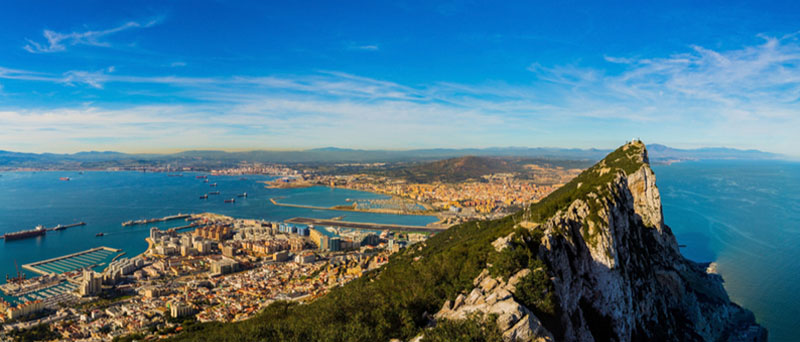
The Rock is undoubtedly the territory’s most famous landmark, and a must-see for many visitors. The monolithic limestone promontory dominates the western entrance to the Mediterranean Sea and offers majestic views across the Strait towards Morocco.
- Height: 1,398 feet (426m) above sea level
- Age: Over 200 million years old, with limestone formed during the Jurassic period
- Famous Residents: The Rock is home to Gibraltar’s Barbary macaques, the only free-ranging population of monkeys in Europe
- Historical Significance: It has been fortified for centuries, with tunnels dating back to the Great Siege of 1779–1783.
Fun Fact: The Great Siege of Gibraltar was one of the longest sieges in British military history, lasting from 1779 until 1783.
The Strait of Gibraltar
The Strait of Gibraltar is the narrow waterway that connects the Atlantic Ocean to the Mediterranean Sea, separating Europe from Africa. It is one of the world’s important maritime passages and a fascinating area to explore.
- Width: At its narrowest point, the Strait is approximately 8.9 miles (14.2 kilometres) wide
- Historical Importance: Because of its strategic location between the Atlantic Ocean and the Mediterranean Sea, the Strait of Gibraltar has long been an important shipping and trade route
- Marine Life: An important migratory route for birds and home to various species of fish, whales and dolphins
Fun Fact: Dolphins are regularly seen in the Bay and Strait of Gibraltar, making dolphin-watching trips one of the area’s popular activities.
History of Gibraltar
Gibraltar’s history dates back to antiquity, and the Rock has been strategically and militarily important for centuries. Below is a brief overview:
- Early inhabitants: Neanderthals occupied caves in Gibraltar tens of thousands of years ago
- Strategic Importance: Gibraltar became particularly important following the arrival of Muslim forces in the Iberian Peninsula in the 8th century
- British Rule: Gibraltar was captured by Anglo-Dutch forces in 1704 and formally ceded to Great Britain under the Treaty of Utrecht in 1713
Read About Gibraltar’s History
Key Historical Dates:
- 1704: Anglo-Dutch forces capture Gibraltar during the War of the Spanish Succession
- 1779–1783: The Great Siege of Gibraltar
- 2002: Gibraltarians overwhelmingly reject a proposal for shared British-Spanish sovereignty in a referendum
Gibraltar’s Economy
Despite its small size, Gibraltar has a diverse economy, with important sectors including financial services, online gaming, maritime services and tourism.
Gibraltar has also developed a regulated financial technology sector. A dedicated Distributed Ledger Technology (DLT) regulatory framework has been in place since January 2018, with relevant firms supervised by the Gibraltar Financial Services Commission.
- GDP per capita: Around £85,000 per person based on the Gibraltar Government’s 2026 GDP forecast
- Main Industries:
- Finance: Financial services remain an important part of Gibraltar’s economy, operating under the supervision of the Gibraltar Financial Services Commission.
- Maritime services: Gibraltar’s strategic position at the entrance to the Mediterranean supports an important port, bunkering and maritime services sector.
- Tourism: Tourism remains an important source of activity for local shops, attractions, hotels, restaurants and transport services.
- Gaming: Gibraltar remains a major international centre for online betting and gaming. Recent government figures put employment in the sector at around 3,300–3,400 people.
Did you know? Gibraltar has no capital gains tax and its standard corporate tax rate is 15%. Higher rates apply to certain utility, telecommunications and dominant-market activities.
Tourism
Tourism is an important part of Gibraltar’s economy, attracting visitors arriving by land from Spain as well as by air, cruise ship and yacht.
The territory’s compact size means that many of its main attractions can be explored within a relatively small area.
- Visitor Arrivals: Gibraltar records millions of visitor movements through its land frontier, airport and port, although official statistics distinguish between tourists, frontier movements and other types of arrivals.
- Top Attractions:
- The Rock and its famous caves and tunnels
- Europa Point, at the southern end of the territory
- The Gibraltar Nature Reserve, home to many of the Rock’s best-known natural and historical attractions
Fun Fact: On a clear day, visitors from several viewpoints on the Rock can see across the Strait towards the coast of North Africa.
Real Estate
The property market can be competitive in Gibraltar, particularly because of the territory’s limited supply of land and strong demand in some residential areas. Opportunities range from modern waterfront developments to apartments in more established neighbourhoods.
Property prices and rents can change considerably according to location, property type and market conditions, so current listings are the best reference when considering a purchase or rental.
- Popular Areas to Live:
- Town Centre for easy access to shops, restaurants and services
- South District for a quieter and predominantly residential environment
- Ocean Village and Marina Bay for modern waterfront living and proximity to the marina
The Border with Spain
The land border between Gibraltar and Spain connects the territory directly with La Línea de la Concepción.
A major change took place on 15 July 2026, when the UK–EU Agreement in respect of Gibraltar entered into provisional application and routine immigration and customs checks at the land frontier were removed.
- Crossing the Frontier: Pedestrians and vehicles can now cross without the systematic entry and exit controls that previously operated at the land border. Traffic congestion can nevertheless still occur at busy periods.
- Documents and Entry Requirements: The removal of routine frontier checks does not remove immigration requirements. Visitors must still meet the entry conditions applicable to Gibraltar and, where relevant, the Schengen Area. Requirements depend on nationality and individual circumstances.
- Political Significance: The new arrangements result from the UK–EU Agreement in respect of Gibraltar, signed on 14 July 2026 following years of negotiations after Brexit.
Brexit and Gibraltar
Brexit reshaped Gibraltar’s relationship with the European Union. After years of negotiations, a new UK–EU Agreement in respect of Gibraltar was signed on 14 July 2026 and has been provisionally applied since 15 July 2026.
Key Points:
- Border and Travel: Routine immigration and customs controls on people crossing the land frontier between Spain and Gibraltar have been removed. Gibraltar has not joined the Schengen Area, but its short-stay entry conditions are now aligned with relevant Schengen requirements.
- Airport and Port: New arrangements apply to passengers arriving in Gibraltar from outside the Schengen Area.
- Gibraltar authorities remain responsible for Gibraltar immigration controls.
- Spanish authorities carry out the relevant Schengen border checks under the treaty arrangements.
- Customs and Trade: The treaty establishes a customs union between Gibraltar and the EU while Gibraltar remains outside the EU Customs Territory. The new system is designed to allow goods to move across the land frontier without routine customs checks, alongside new transaction tax, excise and customs arrangements.
- Status Post-Brexit: Gibraltar remains a British Overseas Territory. The agreement does not alter British sovereignty over Gibraltar and includes specific arrangements protecting UK military operations.
Learn More About Brexit and Gibraltar
Employment Opportunities
Gibraltar supports a diverse workforce, including both residents and thousands of frontier workers who commute from neighbouring Spain. Important employment sectors include financial services, tourism, online gaming, professional services, construction and the public sector.
- Frontier Workers: Cross-border workers form an important part of Gibraltar’s labour market and benefit from the much more fluid land frontier introduced in July 2026.
- Key Sectors for Employment:
- Finance: A developed financial services industry including banking, insurance, investment and related professional services
- Tourism: Employment opportunities in hospitality, restaurants, attractions and customer services
- Online Gaming: Gibraltar remains home to major international online betting and gaming businesses
Weather
Gibraltar enjoys a Mediterranean climate with warm summers and mild winters, making it an appealing year-round destination.
- Average Annual Temperature: Around 20°C (68°F)
- Summer (June–August):
- Average Highs: 25°C–30°C (77°F–86°F)
- Sunshine: Up to 10 hours of sunshine per day
- Rainfall: Generally limited, although occasional showers can occur
- Winter (December–February):
- Average Highs: 14°C–18°C (57°F–64°F)
- Lows: Can drop to around 10°C (50°F)
- Rainfall: More frequent than in summer, but temperatures generally remain mild
Spring (March–May) & Autumn (September–November):
- Mild temperatures: Average highs around 18°C–24°C (64°F–75°F)
- Ideal for outdoor activities: Hiking, exploring the Rock and enjoying the area’s natural beauty
How to Get to Gibraltar
Gibraltar is accessible by land from Spain, by air from the United Kingdom and by sea.
Flights:
- Gibraltar International Airport (GIB) is the territory’s airport.
- Direct Flights: Scheduled services operate to destinations in the UK, with routes and frequencies varying according to season and airline schedules.
- Airlines: British Airways and easyJet are among the main airlines serving Gibraltar.
By Sea:
- Via Spain: Ferry services from Morocco and Ceuta operate to nearby Algeciras in Spain, from where Gibraltar can be reached by road.
- Cruise Ships: Gibraltar is a regular port of call for cruise ships and also receives yachts and other private vessels.
By Land:
- From Spain:
- Road: You can drive into Gibraltar from the neighbouring Spanish town of La Línea de la Concepción.
- On Foot: Gibraltar is easily accessible on foot from La Línea. Routine passport checks at the land frontier were removed on 15 July 2026, although travellers must still meet the applicable entry requirements.
- Public Transport: Bus services connect La Línea with nearby Spanish towns and cities, including Algeciras.
Learn More About Travelling to Gibraltar
Why Gibraltar?
Gibraltar offers a distinctive blend of British and Mediterranean cultures, a diversified economy, a compact urban environment and a remarkable geographical position between Europe and Africa. From its natural landscape to its military history and modern business sectors, the territory has a character unlike anywhere else in the region.
Key Info:
- Population: Around 38,000 residents based on recent Gibraltar Government estimates
- Area: 2.6 square miles (6.8 km²)
- Languages Spoken: English (official), with Spanish widely spoken
- Currency: The Gibraltar Pound (GIP), which is maintained at parity with Pound Sterling. Sterling notes and coins are also widely accepted.
Gibraltar-City.com is your source for in-depth information about this distinctive destination. Whether you’re considering relocating, visiting or simply want to discover more, explore our guides for practical and regularly updated information about Gibraltar.