
If you close your eyes and hear the name ‘Gibraltar’, you no doubt picture the famous Rock of Gibraltar. We’re talking rock with a capital R! Dominating the western entrance to the Mediterranean Sea, the iconic natural landmark has been of historical and strategic importance for centuries.
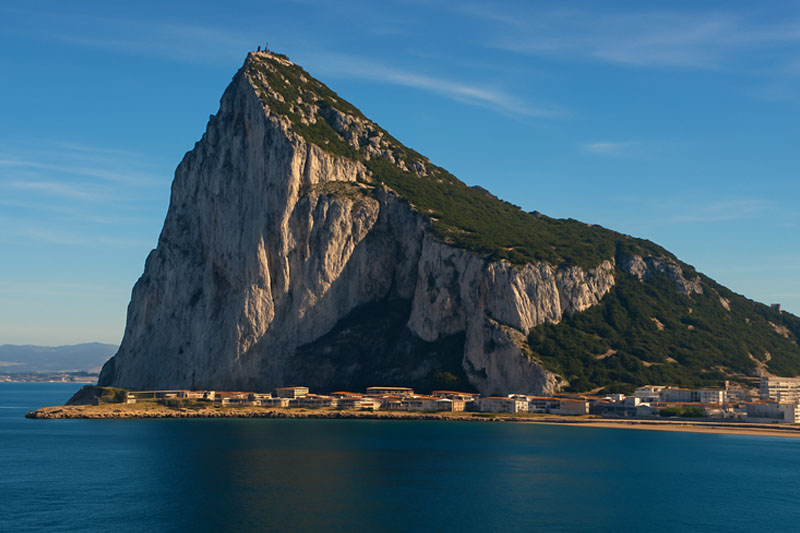
Rising majestically to 1,398 feet (426m) above sea level at the southern tip of the Iberian Peninsula, the Rock of Gibraltar is composed mainly of Jurassic limestone formed approximately 200 million years ago. The highest point of the Rock is at O’Hara’s Battery, near the southern end.
The Pillars of Hercules
The Pillars of Hercules are two prominent rock formations traditionally associated with the entrance to the Strait of Gibraltar. The northern Pillar is the Rock of Gibraltar, known as Mons Calpe in antiquity. The specific location of the southern Pillar, Mons Abila, on the African side of the Strait is traditionally identified as either Monte Hacho in Ceuta or Jebel Musa in Morocco.
The origins of the Pillars of Hercules lie in ancient Greek mythology, later adopted by the Romans. According to the myth, during one of his twelve labours Hercules separated Europe from Africa, creating the Strait and marking the western limit of the known Mediterranean world.
Today, the Pillars of Hercules remain a symbol of the history and strategic importance of the region.
Top of the Rock
Located at the gateway between Europe and Africa, the views from the upper Rock are spectacular. On a clear day, you can admire the Strait of Gibraltar, the Spanish coastline and the mountains of North Africa across the water.
Beyond the views, the Rock offers visitors numerous things to see and do, both above and below ground. Whether you are interested in historical sites, want to see the famous Barbary macaques or enjoy hiking, the Upper Rock combines nature, history and panoramic viewpoints within a relatively compact area.
The Gibraltar Nature Reserve
Much of the Upper Rock forms part of the Gibraltar Nature Reserve. The Upper Rock Nature Reserve was established in 1993 and was subsequently extended and renamed Gibraltar Nature Reserve in 2013.
The Reserve protects important natural habitats while also containing many of Gibraltar’s best-known historic and tourist attractions.
Opening Hours: May–September: 9:30am–7:00pm; October–April: 9:00am–6:00pm. Opening times can change on public holidays or for operational reasons, so check the official Nature Reserve website before visiting.
Access
Unauthorised private vehicles are not normally permitted inside the Nature Reserve. Blue Badge holders and authorised vehicles are permitted under the applicable rules.
Visitors can currently access and explore the Reserve by:
- walking or hiking;
- cycling or e-bike;
- an authorised taxi or Rock tour.
The Gibraltar Cable Car is normally another popular way to reach the Upper Rock, but it is currently closed for a major refurbishment, with reopening expected in 2027.
A standard one-day Nature Reserve ticket provides access to the Reserve and its 17 attractions.
As of September 2026, the official admission prices are:
- Adult: £30
- Child aged 5–11: £22
- Children under 5: Free
Prices can change, so check the official Gibraltar Nature Reserve website before visiting.
Online tickets can be booked in advance and used on a visit within the validity period specified when purchasing. Once activated, the Nature Reserve ticket is valid for that day.
There are three pedestrian entry points to the Nature Reserve: Jews’ Gate, Moorish Castle and Devil’s Gap. Tickets booked online can also be collected from designated ticket offices, including Market Place Bus Station.
Be mindful that summer heat can be intense. If walking or hiking, consider setting off early and take water, sunscreen and a hat.
Walk the Rock
The roads leading up the Rock are generally well maintained, but some sections are steep and require a reasonable level of fitness and comfortable footwear.
Some roads are narrow and are also used by authorised taxis and tour vehicles, so pedestrians should remain aware of passing traffic.
One popular road walking route begins around Castle Road and climbs towards the northern side of the Upper Rock. From there, visitors can reach attractions including the Moorish Castle, Great Siege Tunnels and World War II Tunnels before continuing towards the higher parts of the Reserve.
Other attractions including the Skywalk, St Michael’s Cave and Windsor Suspension Bridge can be incorporated into a longer walking route.
Allow several hours if you want to explore a substantial part of the Reserve on foot.
Hike
If you enjoy hiking and want to move away from the main roads, the Nature Reserve contains a network of trails, pathways and steps.
These routes combine the Reserve’s natural environment and panoramic views with historic sites and can provide a quieter alternative to the roads used by taxis and tour vehicles.
The Nature Reserve currently highlights four themed routes: the History Buff Trail, Thrill Seeker Trail, Nature Lover Trail and Monkey Trail.
More information and route maps are available from the official Nature Reserve website.
Mediterranean Steps
One of Gibraltar’s best-known hiking routes is the Mediterranean Steps, which climbs the eastern side of the Rock through cliffs, Mediterranean vegetation and spectacular viewpoints.
The trail starts at Jews’ Gate at approximately 180m above sea level and climbs towards O’Hara’s Battery at around 419m, close to the summit.
The route is steep and can be demanding. It requires suitable footwear, a reasonable level of fitness and a good head for heights.
Early morning is generally a good time to tackle the trail, particularly during hot weather. In summer, some sections can also offer more shade later in the afternoon.
The Mediterranean Steps are not recommended for visitors with limited mobility.
Cycle
Cycling provides another way to explore Gibraltar and the Upper Rock, although the steep gradients make the climb challenging on a conventional bicycle.
E-bikes can make the ascent more manageable and several local operators offer rentals, guided tours and self-guided routes.
EBike-Gibraltar, for example, offers routes and tours covering the Rock and Nature Reserve. Prices and tour formats can change, so check directly with the operator before booking.
Cable Car: Currently Closed for Refurbishment
Built in 1966 by Swiss manufacturer Von Roll, the Gibraltar Cable Car has traditionally been one of the most popular ways to reach the upper Rock.
Its lower station is located near the southern end of Main Street beside the Alameda Gardens. Under normal operation, the journey to the upper station at approximately 412m above sea level takes around six minutes.
However, the Cable Car is currently undergoing a full refurbishment and is not operating.
The official Gibraltar Nature Reserve website states that it is expected to reopen in 2027.
Visitors travelling in 2026 should therefore plan to reach the Nature Reserve by walking, cycling/e-bike or an authorised taxi or guided Rock tour instead.
Check the official Nature Reserve website before travelling for the latest reopening information.
Taxi or Guided Rock Tour
An authorised taxi or guided Rock tour can be a convenient alternative for visitors who do not want to walk to the upper sections of the Reserve.
Tours typically include several of the main attractions, although the itinerary, duration and price depend on the operator and type of tour selected.
Officially licensed taxi drivers and tour operators offer a range of options. It is advisable to compare the itinerary and current price before booking rather than relying on a fixed tour price.
Attractions in the Gibraltar Nature Reserve
The Nature Reserve contains 17 attractions as well as walking trails, wildlife and viewpoints.
Current opening arrangements for individual attractions can occasionally change because of maintenance or refurbishment, so check the official Nature Reserve website if a particular site is essential to your visit.
For more details visit [www.naturereserve.gi](http://www.naturereserve.gi).
Southern Area
O’Hara’s Battery: Located at the highest point of the Rock of Gibraltar, the gun emplacement is named after General Charles O’Hara, Governor of Gibraltar between 1795 and 1802.
The site contains a 9.2-inch gun and occupies one of the Rock’s most elevated positions. O’Hara’s Battery is currently undergoing refurbishment and is not open to the public, so check its current status before planning your route.
Skywalk: The glass platform and walkway stands around 340 metres above sea level and provides panoramic views across Gibraltar, Spain, the Strait and, in clear conditions, North Africa.
St Michael’s Cave: One of Gibraltar’s most famous natural attractions, this limestone cave is known for its impressive stalactites and stalagmites.
The main cavern has been used as an auditorium since the 1960s and can accommodate approximately 600 people for concerts and other performances.
The cave also features The Awakening, an immersive light and sound experience using projections and lighting to highlight its geological formations.
Visit Visit Gibraltar for more information.
Windsor Suspension Bridge: Opened in 2016, this suspension bridge spans approximately 70 metres across a gorge and provides impressive views of the western side of Gibraltar.
Apes’ Den: Gibraltar’s famous Barbary macaques live freely in several groups around the Upper Rock.
Gibraltar is the only place in Europe where Barbary macaques live freely in the wild. Apes’ Den is one of the best-known locations for seeing them, although the animals can also be encountered elsewhere in the Reserve.
They are wild animals, so visitors should keep a respectful distance. Do not touch or feed the macaques.
Northern Area
The Great Siege Tunnels: British military engineers began excavating the Great Siege Tunnels during the Great Siege of Gibraltar of 1779–1783 to create gun positions within the Rock.
Today, visitors can explore chambers and passageways while learning about the extraordinary military engineering involved in their construction.
World War II Tunnels: During the Second World War, British and Canadian engineers dramatically expanded Gibraltar’s underground military infrastructure.
The complete tunnel network inside the Rock eventually reached approximately 34 miles (around 55km).
The wartime underground complex included accommodation for troops as well as communications facilities, power generation, water supply, medical facilities, ammunition storage and other infrastructure.
Parts of the World War II tunnel system are now open to visitors and provide an insight into Gibraltar’s strategic role during the conflict.
Moorish Castle: Fortifications on and around the site of the Moorish Castle were first constructed in the medieval period. The site was substantially rebuilt following the Marinid recapture of Gibraltar in 1333.
The imposing Tower of Homage is the castle’s most recognisable surviving structure and remains one of Gibraltar’s major historic landmarks.
Final Thoughts
Exploring the Rock remains one of the highlights of a visit to Gibraltar. Its Nature Reserve, historic fortifications, caves, tunnels, macaques, hiking trails and panoramic viewpoints combine within a remarkably small area.
With the Cable Car currently closed for refurbishment, visitors in 2026 should plan their access in advance and decide whether to walk, hike, cycle or use an authorised guided tour.
Tip: Use the Nature Reserve map to choose the attractions you most want to visit and plan your route before setting off. The Rock is steep and the attractions are spread across different elevations, so a little preparation can save considerable walking and backtracking.
Last Updated on September 8, 2026 by Sebastien Frisco