Gibraltar is one of Europe’s smallest territories, yet its economic and strategic importance far exceeds its physical size. In 2026, the British Overseas Territory has experienced one of the most significant changes in its recent history, while continuing to develop its economy, housing, tourism and urban infrastructure.
The year has been particularly important because of the new UK–EU Agreement in respect of Gibraltar, which entered into provisional application in July and fundamentally changed the operation of the land frontier with Spain.
This article provides a fact-based overview of Gibraltar in 2026, covering population, development, tourism, employment, the economy and daily life, using the latest available official figures wherever possible.
A Compact Territory Shaped by Space Constraints
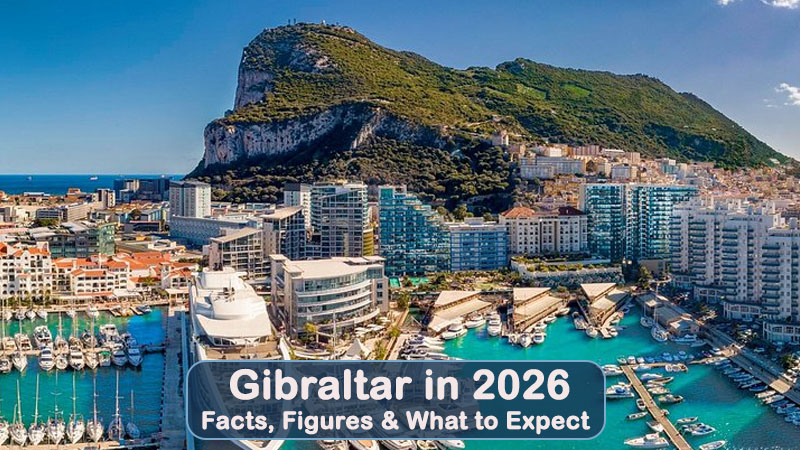
With a total surface area of around 6.8 square kilometres, Gibraltar has little room for conventional urban expansion.
The Gibraltar Government’s 2026 Budget uses an estimated resident population of approximately 38,200 people. Combined with Gibraltar’s small land area, this makes housing, infrastructure and the efficient use of space particularly important.
Development therefore frequently involves land reclamation, higher-density construction and mixed-use projects rather than outward expansion.
This approach has shaped areas such as Ocean Village and Midtown and continues to influence major residential and infrastructure projects around the territory.
Urban Development Continues in 2026
Gibraltar’s skyline and coastline continue to evolve.
The Eastside development remains one of the territory’s largest projects. Full planning permission for its coastal protection works and marina was granted in 2025, and reclamation-related works were still actively taking place in 2026.
Other housing projects have also progressed. The first completions at Chatham Views took place in May 2026, with the development providing a total of 228 apartments.
Work has continued on Bob Peliza Mews, while another major project was approved in May 2026: a new Westside reclamation intended to create around 47,000 square metres of land for affordable housing.
These projects illustrate one of Gibraltar’s defining challenges: creating homes and infrastructure within an exceptionally limited geographical area.
Tourism Remains a Major Part of Gibraltar
Tourism remains highly visible in Gibraltar, but visitor statistics need to be interpreted carefully.
The official Statistics Office does not simply count every frontier movement as a unique tourist. It separates land frontier visitor arrivals, air passengers, cruise passengers and other categories.
In 2025, the latest complete year available, Gibraltar recorded approximately 9.26 million visitor arrivals through the land frontier.
Cruise tourism was also significant, with 355,468 cruise passenger arrivals in 2025.
These figures demonstrate the importance of visitors to Gibraltar while avoiding the misleading assumption that every recorded arrival represents a different tourist.
The territory continues to promote attractions such as the Upper Rock Nature Reserve, St Michael’s Cave, the Great Siege Tunnels, Europa Point and the historic town centre.
Conservation remains an important part of this tourism model. Organisations such as the Gibraltar Ornithological & Natural History Society are active in protecting Gibraltar’s natural environment.
The Biggest Change of 2026: The New Gibraltar Treaty
The most important political and practical development of 2026 has been the conclusion of Gibraltar’s long-running post-Brexit negotiations.
The UK–EU Agreement in respect of Gibraltar was formally signed in Brussels on 14 July 2026 and entered into provisional application on 15 July 2026.
One of its most visible effects was the removal of routine immigration and customs checks at the land frontier between Gibraltar and Spain.
This is particularly important for Gibraltar because thousands of frontier workers live in neighbouring Spain and travel into the territory for employment.
Gibraltar has not joined the European Union or the Schengen Area. Instead, the treaty establishes special arrangements designed to maintain fluid movement across the land frontier while protecting the external Schengen border.
The agreement also introduces a new customs framework, social security coordination for frontier workers and cooperation in a range of other areas.
For a detailed explanation, see our guide to Brexit and Gibraltar.
A Small Economy with Significant Output
Gibraltar continues to generate unusually high levels of economic activity for such a small territory.
According to official figures presented in the 2026 Gibraltar Budget, GDP for 2025/26 is estimated at approximately £3.253 billion.
Based on the government’s estimated resident population of 38,200, this represents approximately £85,145 of GDP per person.
Employment also remains high. The latest Employment Survey recorded a record 32,206 employee jobs, while average annual earnings were reported at approximately £39,511.
Registered unemployment among Gibraltarians remains exceptionally low. The government reported an average of just seven registered unemployed Gibraltarians during the second quarter of 2026, with nine registered in June.
These statistics should nevertheless be interpreted in Gibraltar’s particular context. A substantial part of the workforce consists of people who live outside the territory and commute from neighbouring Spain.
Key Industries in Gibraltar
Gibraltar’s economy is concentrated in several specialised sectors.
Financial services remain important, covering areas including banking, insurance, investment services and professional services.
Online gaming continues to be one of Gibraltar’s best-known international industries, with major operators maintaining activities in the territory.
Maritime services also benefit from Gibraltar’s position at the entrance to the Mediterranean. The port supports bunkering, shipping, logistics and related services.
Tourism and hospitality remain highly visible sectors, while construction and property development continue to play an important role as Gibraltar expands its housing and infrastructure.
The new treaty framework introduced in July 2026 also changes the operating environment for businesses involved in the movement of goods between Gibraltar and the European Union.
Gibraltar and Digital Finance
Gibraltar remains one of the earlier jurisdictions to have introduced a dedicated regulatory framework for businesses using distributed ledger technology (DLT).
Its DLT framework came into operation in 2018, with regulated providers supervised by the Gibraltar Financial Services Commission (GFSC).
The sector remains active in 2026. The GFSC’s current register continues to include authorised DLT providers operating in areas such as digital asset custody, trading and related services.
Rather than describing Gibraltar simply as a “crypto-friendly” jurisdiction, its distinctive feature is the existence of a formal regulatory framework requiring authorised firms to meet regulatory and supervisory standards.
A deeper look at the sector is available in our article: Gibraltar as a global crypto and digital finance hub.
What Has Changed for Daily Life in 2026?
For many residents and workers, the most noticeable change has been at the frontier.
Since 15 July 2026, routine passport and customs booths are no longer part of the normal Gibraltar–Spain land crossing. This has made movement between Gibraltar and neighbouring La Línea considerably more fluid.
However, the treaty has also introduced new rules involving immigration, customs, transaction tax and travel. Gibraltar remains outside both the EU and Schengen, so travellers and residents should still check the requirements that apply to their circumstances.
Housing remains another important issue because of Gibraltar’s limited land supply, while many employees continue to live in Spain and commute across the frontier.
At the same time, investment in housing, transport and public infrastructure continues to reshape parts of the territory.
Gibraltar in 2026: A Year of Important Change
Gibraltar in 2026 has ultimately been defined by a combination of economic continuity and major political change.
The economy remains highly specialised, employment levels are strong and major development projects continue. Tourism brings millions of visitor movements each year, while financial services, gaming and maritime activities remain central to Gibraltar’s economic model.
But the most important development has undoubtedly been the new relationship with the European Union.
After years of post-Brexit uncertainty, the treaty signed in July 2026 has created a new framework for the frontier, customs, workers and relations with neighbouring Spain.
For a territory of only 6.8 square kilometres, Gibraltar continues to occupy an unusually important position at the crossroads of Britain, Europe, the Mediterranean and North Africa.
Last Updated on September 10, 2026 by Sebastien Frisco