
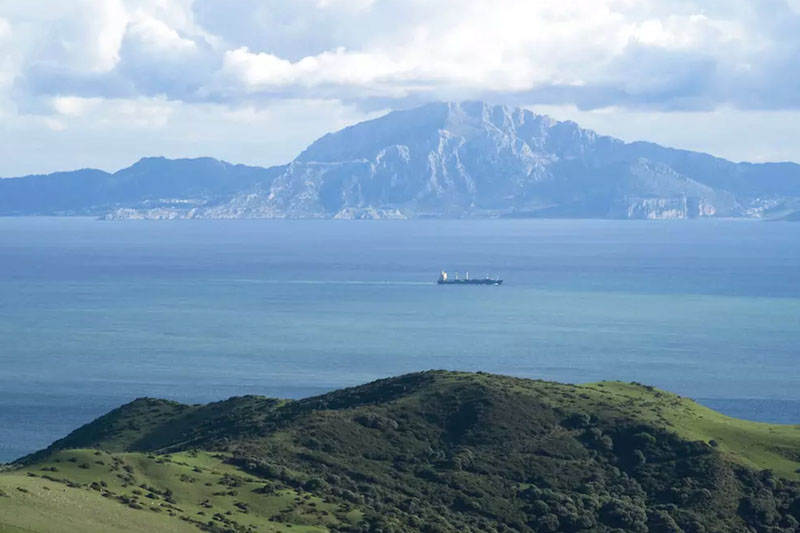
The Strait of Gibraltar is one of the most important and strategically significant maritime passages in the world. Separating Europe and Africa by just 8.9 miles (14.2 kilometres) at its narrowest point, the natural waterway connects the Mediterranean Sea to the Atlantic Ocean.
Gibraltar’s strategic location has historically made it a central point in trade and commerce, geopolitics, and military operations.
Why is it called a Strait?
The noun strait comes from Old French estreit meaning narrow, and the Latin word strictus, meaning “to bind or draw tight.” It refers to a narrow passage of water that connects two larger bodies of water. A strait may be formed by a fracture in an isthmus or by tectonic shifts. Connecting the Mediterranean Sea with the Atlantic Ocean, the Strait of Gibraltar was formed by tectonic activity over millions of years.
Other famous straits include the Bering Strait (between the Pacific and Arctic oceans), the Malacca Strait (connecting the Andaman Sea and the South China Sea), and the Strait of Hormuz (between the Persian Gulf and the Gulf of Oman). A strait forms naturally, whereas a canal is a human-made waterway built for transportation, irrigation, or other purposes. Examples include the Panama Canal and the Suez Canal.
Geography
The Strait of Gibraltar lies between the southernmost tip of Spain and the northern tip of Morocco. The waterway is 36 miles (58 km) long between its entry and exit points, and approximately 8 miles (13 km) wide between Punta de Tarifa (Spain) and Point Cires (Morocco). Its depth ranges from 300 to 900 metres (980 to 2,950 feet), allowing some of the largest ships in the world to pass through.
Winds in the strait are either easterly (levante) or westerly (poniente). Moreover, an exchange of water of different salinity between the Atlantic Ocean and Mediterranean Sea causes strong currents. The water in the Atlantic is less salty and less dense than that in the Mediterranean, so a surface current flows eastward through the centre of the channel.
Historical Significance
Historically, straits have always had great strategic importance. Indeed, whoever controls a strait is likely to control the sea and shipping routes of the entire region.
The Strait of Gibraltar has been a vital passageway for centuries, serving as a key trade and military route between the Mediterranean and the Atlantic. From Roman times to the Moorish conquest, and more recently during both World Wars, the ability to control the waterway has often determined the outcome of conflicts in the Mediterranean region.
Gibraltar’s Role in Managing the Strait
On the northern side of the Strait, the British Overseas Territory of Gibraltar plays a vital role in overseeing and managing maritime traffic. With its naval base and port facilities, Gibraltar ensures constant monitoring of ships passing through. Alongside Spain and Morocco, Gibraltar contributes to the security and regulation of this vital waterway.
Economic and Geopolitical Importance
Given its strategic location, the Strait has been the centre of intense geopolitical dynamics for centuries. The region remains a focal point for global powers aiming to secure maritime trade routes, control energy flows, and assert dominance. Today, the body of water serves as a globally important shipping route for vessels transporting goods between the Atlantic and Mediterranean, and via the Suez Canal into the Indian Ocean and beyond. According to the Gibraltar Port Authority, approximately 60,000 vessels transit the Strait of Gibraltar each year. They transport essential commodities like oil, natural gas, foodstuffs, and manufactured goods. Additionally, Gibraltar is one of the largest and busiest bunkering ports in the Mediterranean—a key economic activity.
Military Infrastructure and Defence
The Strait of Gibraltar is of major military significance. Gibraltar’s British HM Naval Base is strategically positioned to monitor naval movements in the area. It also provides repair, resupply, and logistics support. In addition, the British Army and Royal Air Force have a presence in Gibraltar which contributes to the defence of the region. Both Spain and Morocco also maintain military bases along their respective coasts. Defending this region is crucial for controlling access to the Mediterranean, particularly in times of geopolitical tension or conflict.
Ecology and Marine Life
The Bay of Gibraltar is a rich feeding ground for cetaceans and the Strait is home to seven species of whales and dolphins. It is also an important migration route for seabirds including yellow-legged and lesser black-backed gulls, razorbills, and Atlantic puffins. Furthermore, the waterway represents an important zone for plant biodiversity within the Mediterranean Basin.
Challenges Facing the Strait
The Strait of Gibraltar faces several challenges. In addition to political tensions over sovereignty and maritime rights, issues such as piracy, illegal immigration, and environmental risks from oil spills present ongoing problems. Furthermore, the increasing traffic combined with pollution threats put pressure on the waterway’s delicate marine ecosystem, creating a need for sustainable management.
Recent Developments and Future of the Strait
A proposed €6 billion underwater tunnel project aims to connect Spain and Morocco beneath the Strait of Gibraltar by 2040. The project involves constructing a 42-kilometre tunnel, with nearly 30 kilometres submerged at depths reaching 475 meters.
The Strait of Gibraltar continues to evolve in the face of modern challenges. Environmental concerns, expanding international trade, and geopolitical tensions are all shaping the region’s future. The Strait’s longstanding historic and strategic significance remains as important as ever.
Last Updated on May 17, 2025 by Vanessa Kingwell