
Coming in to land at Gibraltar International Airport is a thrilling and memorable experience, offering spectacular views of the British Overseas Territory and its iconic Rock. The runway runs east-west across the narrow northern end of Gibraltar, with the Mediterranean on one side and the Bay of Gibraltar on the other.
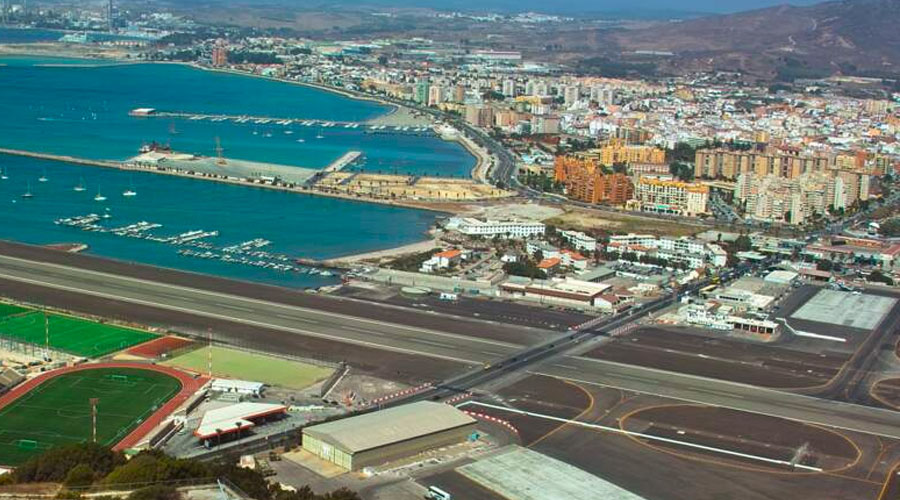
Gibraltar International Airport is famous for several unusual features. Until 2023, the main road to the Spanish frontier—Winston Churchill Avenue—crossed directly over the airport runway. Vehicles had to stop whenever aircraft were landing or taking off.
A major change came on 31 March 2023, when the Kingsway Tunnel opened beneath the eastern side of the runway. Cars, motorcycles, vans and other regular road traffic now use the tunnel rather than crossing the runway.
Pedestrians, cyclists and users of certain small mobility devices can still cross the runway itself, making the airport one of Gibraltar’s most unusual sights.
Another distinctive feature is that approximately one-third of the runway projects out into the sea. Gibraltar’s geography, including the proximity of the Rock, can also produce challenging wind and turbulence conditions for aircraft.
The airport operates as both a civilian airport and a military airfield, with aviation safety responsibilities shared between the relevant Gibraltar authorities and the Ministry of Defence.
According to official airport statistics, Gibraltar International Airport handled 437,172 passenger movements in 2025, together with 3,762 aircraft movements and approximately 106,940 kg of cargo, mail and courier traffic.
History of the Airport
The origins of Gibraltar’s airfield date back to the 1930s.
Work on a grass landing strip on the former horse racing ground began in 1934 and was completed in March 1936. Construction of a more permanent runway began shortly before and during the early stages of World War II.
The airfield became particularly important during the war. Major expansion works began in 1941 and 1942, with material excavated from the Rock used to reclaim land from the Bay of Gibraltar and extend the runway westwards.
RAF North Front became operational as a major military airfield during this period and played an important role in Allied operations in the Mediterranean and North Africa.
Today, the Ministry of Defence owns the runway and associated military airfield, which is operated as RAF Gibraltar, while the Government of Gibraltar operates the civilian air terminal.
Direct Flights to Gibraltar
As of September 2026, two airlines operate regular scheduled passenger services to Gibraltar: easyJet (www.easyjet.com) and British Airways (www.britishairways.com).
Current scheduled routes connect Gibraltar with:
- London Heathrow – British Airways
- London Gatwick – easyJet
- Manchester – easyJet
- Bristol – easyJet
- Birmingham – easyJet
Routes and frequencies vary according to the season, so travellers should consult the official Gibraltar Airport timetable before booking.
At present, scheduled commercial services are concentrated on the United Kingdom. However, the 2026 UK–EU Agreement in respect of Gibraltar has created a new legal framework allowing flights between Gibraltar and airports in the European Union.
Under the treaty, EU airlines will be able to operate between Gibraltar and EU destinations, while UK airlines will continue to operate Gibraltar–UK routes.
This represents a significant change from the restrictions that affected Gibraltar Airport for decades. Future EU routes will depend on commercial decisions by airlines and the implementation of the treaty’s aviation arrangements, so passengers should not assume that a particular European route is available until it appears in official airline or airport schedules.
Passport and Entry Requirements
Entry arrangements changed significantly on 15 July 2026, when the UK–EU Agreement in respect of Gibraltar entered into provisional application.
Gibraltar remains outside both the European Union and the Schengen Area. However, its entry conditions for short-stay visitors are now formally aligned with relevant Schengen requirements.
Travellers must carry a valid travel document appropriate to their nationality. This may be a passport or, where permitted, a valid national identity card.
At Gibraltar International Airport, passengers arriving from outside the Schengen Area should expect two sets of immigration checks:
- Gibraltar authorities conduct Gibraltar entry controls.
- Spanish authorities conduct the relevant Schengen entry controls under the treaty arrangements.
The EU Entry/Exit System (EES) also applies at the airport where relevant.
For British visitors, short stays in Gibraltar are now subject to the same general 90 days in any 180-day period framework used for the Schengen Area, and time spent in Gibraltar counts together with time spent elsewhere in Schengen for this purpose.
Visa requirements depend on nationality. Since July 2026, travellers who require a visa for a short stay should check whether they need a Schengen short-stay visa before travelling.
For the latest rules, consult the UK Government’s Gibraltar entry requirements and the Gibraltar Borders and Coastguard Agency.
Crossing the Runway
One of Gibraltar Airport’s most unusual features remains accessible to visitors: pedestrians can still cross the runway at Winston Churchill Avenue.
The opening of the Kingsway Tunnel in 2023 ended regular vehicle crossings, but pedestrians, cyclists, scooter and e-scooter riders and mobility scooter users are still permitted to use the runway crossing.
There is also a separate pedestrian and cycling route through the Kingsway Tunnel area, so crossing the active runway is not the only way to travel between the airport/frontier area and the rest of Gibraltar.
If you choose the runway crossing, remember that it remains part of an active military and civilian airfield. RAF Gibraltar advises users to:
- Follow all instructions given by police officers and airport staff.
- Stay within the designated lane.
- Do not stop unnecessarily or linger on the runway.
- Secure loose belongings and never drop litter, which can present a danger to aircraft.
- Keep children and pets under close supervision.
- Stop when the red lights are illuminated or the barriers are closed and wait until permission is given to cross.
The crossing can close whenever aircraft movements require it.
The Terminal Building
The civilian terminal is located on British Lines Road at the northern end of Gibraltar, close to both the Spanish frontier and the airport runway.
The town centre is within walking distance, while taxis and public buses provide easy connections to other parts of Gibraltar.
The terminal provides passenger facilities including baggage reclaim, departure areas, car rental services, food and drink outlets and duty-free shopping.
Current retail outlets include businesses such as WH Smith, Gibraltar Duty Free Shops, The Food Hall & The Pub, Memories of Gibraltar and other travel and retail services. Shops and facilities can change, so travellers should check the airport website for current information.
A New Era for Gibraltar Airport
The 2026 Gibraltar treaty represents one of the biggest changes in the airport’s modern history.
Since 15 July 2026, the airport has become one of the principal locations where the new Gibraltar and Schengen immigration arrangements operate. At the same time, the treaty creates the possibility of commercial flights between Gibraltar and destinations elsewhere in the European Union.
The ownership of the airport infrastructure has not changed: the runway and associated military facilities remain under the UK Ministry of Defence, while Gibraltar retains its civilian terminal and aviation responsibilities.
For now, Gibraltar International Airport remains a compact gateway primarily connecting the territory with the United Kingdom. But the new aviation framework means that its route network could become considerably more diverse in the years ahead.
Combined with its dramatic location beside the Rock, its runway extending into the sea and the unusual pedestrian crossing, Gibraltar International Airport remains one of the Mediterranean’s most distinctive airports.
Last Updated on September 10, 2026 by Sebastien Frisco