
The land border between Spain and Gibraltar, often referred to as ‘The Fence’ (‘La Verja’), is the international land boundary separating the British Overseas Territory of Gibraltar from La Línea de la Concepción in southern Spain.
The border runs east-west for approximately 0.75 miles (1.2 km). Since 15 July 2026, routine immigration and customs checks at the land frontier have been removed under the new UK–EU Agreement in respect of Gibraltar.
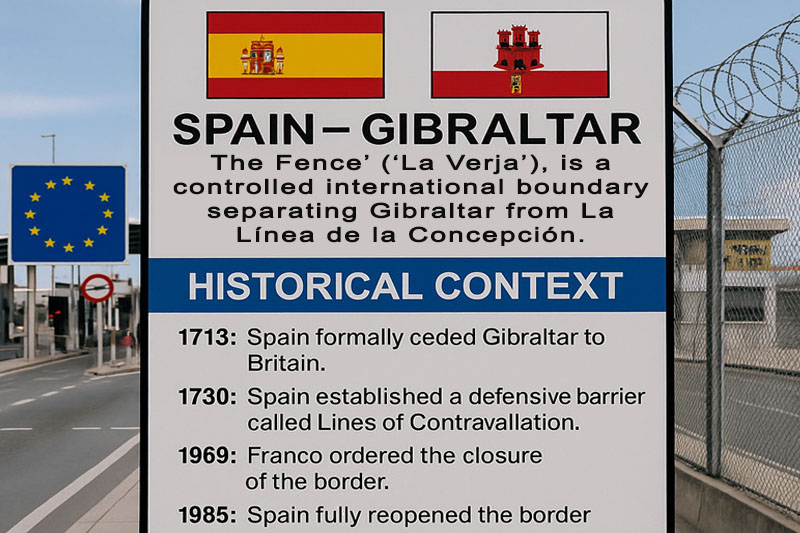
Historical Context
- 1713: Spain formally ceded Gibraltar to Britain under the Treaty of Utrecht.
- 1730: The Lines of Contravallation of Gibraltar were a set of fortifications built by the Spanish. They established a defensive barrier across the peninsula, with the aim of preventing British incursions. The area where the lines once stood is now part of the Spanish town of La Línea de la Concepción, which was named after them (‘La Línea’ means ‘The Line’ in Spanish).
- 8 June 1969: Francisco Franco ordered the closure of the border in response to the Gibraltar Constitution Order and the 1967 sovereignty referendum, when Gibraltarians overwhelmingly voted to retain their links with Britain.
- 15 December 1982: The frontier was partially reopened to Spanish and Gibraltarian pedestrians.
- 5 February 1985: Spain fully reopened the border, ahead of its entry into the European Economic Community (EEC) in 1986.
- 15 July 2026: Routine entry and exit checks at the land border were removed following the provisional application of the new UK–EU Agreement in respect of Gibraltar.
Crossing the Border
- The border remains one of the busiest links between Gibraltar and neighbouring Spain, with residents, workers and visitors travelling between the two sides every day.
- Since 15 July 2026, there are no longer routine entry and exit check booths for people crossing the land border between Gibraltar and Spain. Pedestrians and vehicles can therefore cross without the systematic passport controls that previously operated at the frontier.
- Around 15,000 frontier workers cross between Spain and Gibraltar each working day, forming an important part of Gibraltar’s workforce. Many live in neighbouring Spanish municipalities.
- The removal of routine border checks does not remove immigration requirements. Travellers must still meet the relevant conditions for entry into Gibraltar and, where applicable, the Schengen Area.
- Gibraltar itself has not joined the Schengen Area or the European Union. Instead, the treaty creates special arrangements designed to allow fluid movement across the land frontier while protecting the external Schengen border.
- Traffic congestion can still occur, particularly at busy periods. The Gibraltar Frontier Queue live cameras remain useful for checking traffic conditions before travelling.
- There are still customs rules governing goods brought into or taken out of Gibraltar. Under the new treaty arrangements there are no routine customs checks on travellers with goods at the land frontier, but allowances, declarations and taxation rules can still apply. Visit the HM Government of Gibraltar’s official Customs website for current guidance.
- Maritime matters and Gibraltar’s port are administered by the Gibraltar Port Authority.
Current Political Situation
In June 2025, the UK, Spain, Gibraltar and the European Union reached a political agreement on Gibraltar’s future relationship with the EU following Brexit.
After further legal negotiations, the final UK–EU Agreement in respect of Gibraltar was signed in Brussels on 14 July 2026. It entered into provisional application on 15 July 2026, bringing the new border arrangements into practical effect.
The most visible change is at the Gibraltar–Spain land frontier. Routine immigration checks and physical entry and exit booths have been removed, allowing much more fluid movement for residents, frontier workers and visitors.
The agreement does not make Gibraltar part of either the European Union or the Schengen Area. Instead, it creates a special system under which Gibraltar remains outside Schengen while its short-stay visitor entry conditions are aligned with relevant Schengen requirements.
For passengers arriving in Gibraltar from outside the Schengen Area, new border procedures operate at Gibraltar Airport. Gibraltar authorities retain responsibility for entry into Gibraltar, while Spanish authorities carry out the necessary Schengen checks under the treaty arrangements. Similar provisions can apply at the port where required.
The absence of routine controls at the land border therefore does not mean that Gibraltar can be used to bypass Schengen visa or immigration requirements. Travellers must still hold the documentation required for their nationality and circumstances.
The treaty also establishes a bespoke customs framework between Gibraltar and the EU designed to remove routine customs checks on goods at the land frontier. Specific rules continue to apply to allowances, declarations, taxation and certain categories of goods.
The agreement includes provisions covering frontier workers, taxation, customs cooperation, law enforcement and other areas intended to support economic activity on both sides of the border.
British sovereignty over Gibraltar is not changed by the treaty. The agreement also protects the autonomous operation of UK military facilities, including the RAF presence in Gibraltar.
The treaty is currently being applied provisionally while the formal ratification procedures are completed. Its provisional application has nevertheless meant that the new practical arrangements have been operating since 15 July 2026.
For the latest official information, travellers can consult the UK Government’s Gibraltar entry requirements, the Government of Gibraltar and the official documentation relating to the UK–EU Agreement in respect of Gibraltar.
Last Updated on September 10, 2026 by Sebastien Frisco