
When you think of cryptocurrency, places like Silicon Valley, Dubai or Switzerland probably come to mind. However, one smaller jurisdiction has also built a strong reputation in the digital asset sector: Gibraltar.
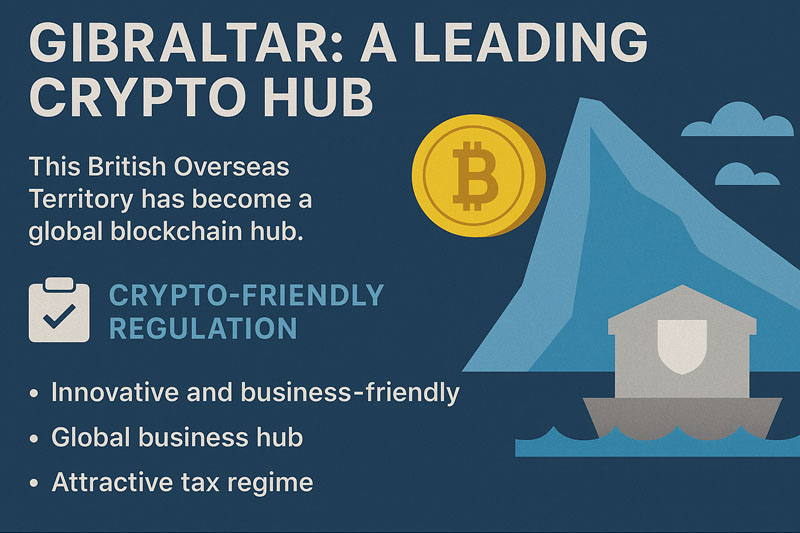
Located at the southern tip of the Iberian Peninsula, this British Overseas Territory covers an area of just 6.8 km² (2.6 square miles). Despite its size, Gibraltar has established itself as a specialist jurisdiction for blockchain, Distributed Ledger Technology (DLT) and virtual asset businesses.
So what has helped Gibraltar attract companies operating in this highly specialised sector? Before looking at its regulatory framework, let’s first define a few key terms.
Cryptocurrency and Blockchain Technology
A cryptocurrency is a type of digital or virtual asset that generally uses cryptography and distributed ledger technology to record transactions.
Many cryptocurrencies operate on decentralised networks rather than through a traditional central bank or payment provider. However, not every crypto asset or blockchain system is fully decentralised, and the structure varies considerably between projects.
Cryptocurrency can allow value to be transferred directly between digital wallets across borders. However, transaction times and fees depend on the network, exchange or service being used and can vary significantly.
The first and best-known cryptocurrency is Bitcoin, launched in 2009. Since then, thousands of different crypto assets and tokens have been created, although a relatively small number account for much of the market.
Cryptocurrency transactions are commonly recorded using Distributed Ledger Technology (DLT). DLT allows records to be stored and synchronised across multiple participants or computer systems rather than relying on a single traditional database.
Blockchain is the best-known form of DLT. Transactions are grouped into blocks which are cryptographically linked to previous blocks, creating a chronological record.
Blockchain records are designed to be highly resistant to alteration once confirmed. However, this does not mean that cryptocurrency itself is automatically secure or risk-free. Users can still face risks including fraud, cybercrime, loss of private keys, exchange failures and sharp price movements.
Crypto assets are usually accessed through exchanges or other service providers and stored using digital wallets. Control of a wallet normally depends on cryptographic keys rather than simply an encrypted password.
Now, let’s get back to Gibraltar!
Why Does Gibraltar Attract Crypto Companies?
- An Early Regulatory Framework
Gibraltar was one of the earliest jurisdictions to introduce a dedicated legal framework for businesses using Distributed Ledger Technology.
Its purpose-built DLT regulatory framework came into effect on 1 January 2018. Businesses using DLT to store or transmit value belonging to others in or from Gibraltar became subject to authorisation by the Gibraltar Financial Services Commission (GFSC).
The original framework has evolved significantly since then.
Today, the regulatory regime operates principally under the Financial Services Act 2019 and the Financial Services (DLT Providers and VAA Providers) Regulations 2020, which have subsequently been amended, including during 2025 and 2026.
The current framework distinguishes between regulated DLT Providers and Virtual Asset Arrangement Providers (VAA Providers), depending on the type of activity being carried out.
The GFSC maintains public registers allowing users and businesses to check which firms are currently authorised.
- Principles-Based Regulation
Rather than simply describing Gibraltar as “crypto-friendly”, it is more accurate to describe it as a jurisdiction that has deliberately developed a regulated environment for digital asset businesses.
The GFSC applies a principles-based approach.
Current DLT and VAA rules require regulated providers to meet 10 regulatory principles covering areas including:
- honesty and integrity;
- fair treatment of customers;
- adequate financial and non-financial resources;
- effective management and corporate governance;
- protection of customer assets;
- IT systems and security;
- anti-money laundering and financial crime controls;
- operational resilience;
- market integrity.
The GFSC authorisation process examines areas including the business model, capital, key individuals, risk management, IT systems, governance, financial crime controls and customer protection.
Obtaining authorisation is therefore not simply a registration exercise.
- An Established Financial Services Environment
Gibraltar has long specialised in regulated industries including financial services and online gaming, giving the jurisdiction experience in licensing international businesses, compliance and cross-border regulation.
The local professional-services sector includes lawyers, accountants, compliance specialists and corporate-service providers familiar with regulated businesses and international structures.
Gibraltar also offers a competitive business tax environment. The standard corporate tax rate is currently 15%, although the actual tax treatment of a company depends on where its taxable income accrues or is derived and on the nature of its activities.
Gibraltar’s Current DLT and Virtual Asset Sector
Gibraltar continues to host authorised digital asset businesses.
The GFSC Regulated Entities Register contains a current list of authorised DLT Providers, while Virtual Asset Arrangement Providers are listed separately.
Because the composition of these registers changes as businesses obtain, surrender or amend permissions, checking the current GFSC register is more reliable than relying on a permanent list of crypto companies in an article.
Regulated firms must continue to satisfy the GFSC’s requirements after authorisation and are subject to ongoing supervision.
Key Advantages for Digital Asset Businesses in Gibraltar
Potential advantages include:
✅ Established regulatory framework – Gibraltar has regulated DLT businesses since 2018 and continues to update its legislation as the sector develops.
✅ Dedicated financial regulator – The GFSC has specialist experience supervising DLT and virtual asset businesses.
✅ Principles-based supervision – Regulation covers governance, financial resources, technology, customer protection, resilience and market integrity.
✅ Financial crime controls – Regulated providers must maintain systems designed to prevent, detect and report money laundering and other financial crime risks.
✅ Professional services ecosystem – Gibraltar has established legal, accounting, compliance and corporate-service sectors.
✅ Competitive corporate tax environment – The standard corporation tax rate is currently 15%, subject to Gibraltar’s tax rules and the circumstances of each company.
✅ International location – Gibraltar maintains close economic links with the UK, Spain and international markets.
Does Gibraltar Provide Access to the EU Crypto Market?
This point requires particular care.
Gibraltar’s new relationship with the European Union has improved arrangements concerning the land frontier and trade in goods. However, the 2026 UK–EU Agreement in respect of Gibraltar does not establish general free movement of services.
A financial, technology or virtual-asset company authorised in Gibraltar therefore does not automatically receive the right to provide regulated services throughout the European Union.
Businesses wishing to operate in other jurisdictions must consider the relevant licensing and regulatory requirements in those markets.
Gibraltar’s geographic location and international connections can still be commercially useful, but they should not be confused with automatic regulatory access to the EU single market.
Navigating Gibraltar’s Digital Economy
Gibraltar remains an established jurisdiction for businesses using blockchain and virtual assets, but obtaining regulatory approval requires significant preparation.
The GFSC encourages prospective applicants to engage with the regulator at an early stage to determine whether their proposed activity falls within the DLT or other financial-services frameworks.
Applicants may need to demonstrate appropriate:
- capital and financial resources;
- management expertise;
- corporate governance;
- IT and cybersecurity systems;
- risk-management procedures;
- consumer-protection measures;
- AML and financial-crime controls;
- operational resilience.
This makes Gibraltar very different from an unregulated “offshore crypto” jurisdiction. Its proposition is based primarily on providing a defined regulatory framework for firms prepared to meet supervisory standards.
Final Thoughts
Gibraltar may be small, but it has played an important role in the development of regulated blockchain and virtual asset businesses.
Its introduction of a purpose-built DLT framework in 2018 placed it among the early movers in digital asset regulation, and the legal framework has continued to evolve.
In 2026, the sector is governed through the Financial Services Act and updated rules covering both DLT Providers and Virtual Asset Arrangement Providers, with authorised businesses supervised by the GFSC.
The industry still faces challenges including cybersecurity, financial crime, international regulatory change and competition from other jurisdictions. Gibraltar’s advantage is therefore not simply that it is “crypto-friendly”, but that it has chosen to combine innovation with formal regulation and ongoing supervision.
For anyone researching a specific crypto or DLT business in Gibraltar, the best starting point is the current GFSC Regulated Entities Register.
Last Updated on September 10, 2026 by Sebastien Frisco