Gibraltar is one of Europe’s smallest territories, yet its influence on tourism, finance and cross-border employment far exceeds its physical size. As 2026 approaches, the territory is not heading toward a sudden transformation, but rather toward a continuation of trends that are already clearly visible today. These developments are supported by official statistics, long-term urban planning and economic policies that have been shaping Gibraltar for more than a decade.
This article offers a realistic and fact-based outlook on Gibraltar in 2026, exploring population dynamics, urban development, tourism, economic sectors and daily life. The perspective is grounded in verified data and reflects how the Rock is positioning itself within a changing European and global context.
A Compact City Shaped by Space Constraints
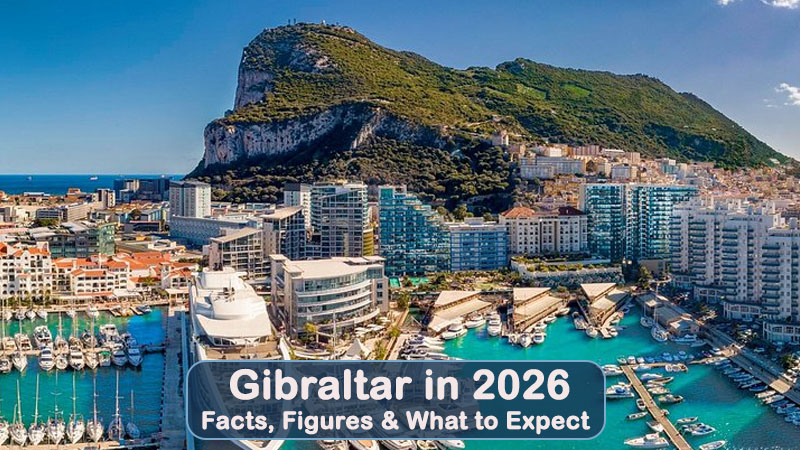
With a total surface area of just 6.8 square kilometres, Gibraltar faces a structural challenge that defines almost every policy decision: space is extremely limited. According to the Gibraltar Statistics Office, the resident population is currently estimated at around 34,000 people, placing Gibraltar among the most densely populated territories in Europe, with well over 5,000 inhabitants per square kilometre.
Looking ahead to 2026, population growth is expected to remain modest and tightly controlled. Demand to live and work in Gibraltar remains strong, but housing availability acts as a natural limiter. As a result, the government’s long-term urban strategy focuses on land reclamation, vertical construction and mixed-use developments rather than outward expansion. This approach allows Gibraltar to accommodate residents, offices and services without compromising essential infrastructure.
Urban Projects That Will Define Gibraltar in 2026
Over the past decade, Gibraltar’s skyline has undergone a visible transformation. Developments such as Ocean Village, Midtown and the Eastside reclamation project are not short-term responses to demand, but part of a long-term vision that will still be shaping the city in 2026.
These projects integrate residential housing, office space, retail areas, leisure facilities and hospitality services into compact zones designed for efficiency. By 2026, most of these developments are expected to be fully operational, helping to ease housing pressure while supporting Gibraltar’s service-based economy and modern urban lifestyle.
Tourism: A Pillar That Continues to Evolve
Tourism remains one of Gibraltar’s most important economic pillars. In normal conditions, official figures from the Gibraltar Tourist Board and the Statistics Office indicate that the territory welcomes over 12 million visitors per year. The majority are day visitors, many of whom arrive from Spain via the land border, while cruise tourism contributes between 200,000 and 250,000 passengers annually.
As Gibraltar looks toward 2026, the focus is not simply on increasing visitor numbers. Instead, the strategy prioritises improving the quality of the visitor experience, encouraging longer stays, increasing average spending and ensuring that tourism growth does not damage Gibraltar’s natural and historical assets. Sites such as the Upper Rock Nature Reserve play a central role in this approach, with conservation efforts supported by organisations like the Gibraltar Ornithological & Natural History Society.
Brexit and Gibraltar’s Unique Position
No realistic outlook toward 2026 can ignore the lasting impact of Brexit. Gibraltar left the European Union alongside the United Kingdom, yet its situation remains unique due to its geographic location and economic reliance on cross-border movement. Thousands of workers continue to commute daily from Spain, making border fluidity a crucial issue for Gibraltar’s economy and daily life.
Ongoing negotiations between the UK, Gibraltar and the EU aim to establish a long-term framework that preserves mobility while respecting new political realities. While uncertainty remains, Gibraltar has demonstrated resilience since Brexit, maintaining low unemployment and economic stability.
A detailed breakdown of how Brexit affects Gibraltar, border arrangements and everyday life can be found in this dedicated analysis: Brexit and Gibraltar.
A Small Economy with Remarkable Output
Despite its size, Gibraltar consistently records one of the highest GDP per capita levels in Europe. Official estimates place total GDP between £2.4 and £2.7 billion, while unemployment remains exceptionally low, typically around 2 to 3 percent. These figures underline the efficiency of Gibraltar’s highly specialised economy.
Financial services, insurance, online gaming, maritime services and port operations continue to form the backbone of economic activity. The Port of Gibraltar remains a strategic asset thanks to its location at the entrance of the Mediterranean, supporting bunkering, shipping and logistics linked to global trade routes.
Gibraltar and the Rise of Crypto and Digital Finance
One of the most significant economic developments shaping Gibraltar’s future is its growing role in the global crypto and digital finance sector. Gibraltar was among the first jurisdictions in the world to introduce a clear regulatory framework for distributed ledger technology (DLT), attracting blockchain companies, crypto exchanges and fintech firms seeking legal certainty.
By 2026, this sector is expected to be firmly embedded within Gibraltar’s economy, complementing traditional financial services rather than replacing them. Regulation, transparency and compliance have become key selling points, positioning Gibraltar as a credible and well-regulated crypto hub rather than a speculative offshore centre.
A deeper look at this transformation is available in this article: Gibraltar as a leading global crypto hub.
Looking Toward 2026
Gibraltar’s outlook for 2026 is defined less by dramatic change and more by continuity, stability and strategic adaptation. Controlled urban growth, sustainable tourism, economic diversification and careful management of post-Brexit realities all point toward a territory that is evolving without losing its core strengths.
For residents, workers and visitors alike, Gibraltar in 2026 is likely to feel familiar yet more refined, a compact city that continues to punch well above its weight on the European and global stage.
Last Updated on February 20, 2026 by Sebastien Frisco