
The Strait of Gibraltar, the busy waterway between southern Spain and northern Morocco, is well known for its rich marine biodiversity. Since 2020, it has also attracted international attention because of a highly unusual phenomenon: Iberian orcas interacting with sailing boats and other small vessels.
During some of these encounters, the animals repeatedly push or strike rudders, sometimes damaging them severely enough to leave a boat unable to steer. Although these interactions can be frightening and have caused serious damage to several vessels, researchers caution against describing them as deliberate “attacks”.
One widely reported incident occurred in May 2024, when orcas damaged the rudder of a sailing yacht in the Strait. Water entered the vessel and the two people on board were rescued by a nearby tanker. The yacht was eventually lost.
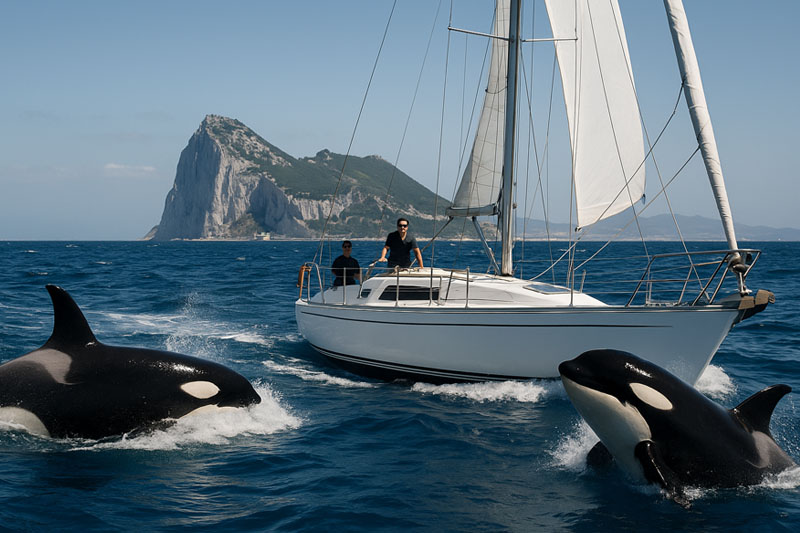
By early 2024, researchers had documented at least 673 interactions involving Iberian orcas since the behaviour was first reported in May 2020. Most involved sailing boats, with the animals showing a particular interest in their rudders.
Interactions have continued since then, but recent official monitoring provides some encouraging news. During the summer of 2025, Spanish authorities reported that interactions in the Gulf of Cádiz and Strait of Gibraltar decreased significantly, continuing a downward trend seen in recent years.
So What Explains This Unusual Orca Behaviour?
Scientists still do not have a definitive explanation, but an international workshop of orca experts held in 2024 concluded that there was no evidence that the behaviour was aggressive.
Instead, the interactions appear to have more in common with play, social behaviour or a temporary behavioural “fad”.
Curiosity and Play: Orcas are highly intelligent and curious animals. Researchers have observed that younger individuals are particularly likely to explore and manipulate objects in their environment. The behaviour may have begun as playful interaction with rudders before becoming more forceful as the animals grew.
Social Learning: Orcas live in close social groups and are well known for learning behaviours from one another. This could help explain why interactions with boats became concentrated among particular individuals and groups.
More Available Prey: Iberian orcas feed primarily on Atlantic bluefin tuna. Tuna numbers have recovered significantly compared with the shortages experienced in the 2000s. Researchers have suggested that easier access to prey may leave the whales with more time and energy for exploratory or playful behaviour.
Climate and environmental changes may also influence the distribution and availability of tuna, although scientists continue to investigate how these factors affect the orcas.
What researchers currently do not have evidence for is the popular idea that the animals are deliberately taking revenge on boats following a previous negative experience.
Safety Tips for Boaters
If you’re planning to sail through the Strait of Gibraltar or Gulf of Cádiz, it is important to follow the latest official guidance.
- Avoid high-risk areas where possible: Spanish authorities recommend avoiding the designated high-risk zone in the Gulf of Cádiz and Strait of Gibraltar during the main period of orca activity, particularly from April to August. Routes should be planned as close to the coast as safely possible.
- Do not stop the boat during an interaction: Current guidance for both sailing and motor vessels is to keep moving and head towards the coast or shallower water, provided this can be done safely.
- Keep people away from the sides: Crew and passengers should remain in protected areas of the vessel in case sudden movements or impacts cause falls or injuries.
- Do not use harmful deterrents: Avoid actions or devices that could injure, disturb or harass the animals.
- Report the encounter: Sightings and interactions should be reported as soon as possible to the nearest maritime rescue coordination centre, normally using VHF Channel 16.
If it is safe to do so, photographs can also help researchers identify the individual animals involved.
What Marine Experts Are Doing
Scientists and maritime authorities continue to monitor the Iberian orca population and its interactions with vessels.
Researchers use methods including satellite tracking, photo identification, reports from sailors and analysis of vessel interactions to better understand where the animals travel and why some individuals interact with boats.
An international workshop held in Madrid in 2024 brought together orca specialists and authorities from Spain, Portugal and Morocco. Its recommendations now form an important part of the official safety guidance given to sailors.
The Iberian orca population is small, making protection of the animals an important part of the response. Authorities therefore seek to reduce risks both to people at sea and to the orcas themselves.
Interactions Are Declining in the Strait
There is also some positive news.
In April 2026, Spanish environmental and maritime authorities reported that the number of vessel-orca interactions had continued to fall significantly in the area between the Gulf of Cádiz and the Strait of Gibraltar during the previous summer.
The authorities nevertheless continue to publish risk maps and navigation recommendations because interactions can still occur.
Boaters should therefore check the latest official maritime guidance before travelling, particularly during the spring and summer months.
Final Thoughts: Coexisting with Orcas
The orca interactions around the Strait of Gibraltar remain an extraordinary example of complex animal behaviour.
Scientists now consider play and social behaviour more plausible explanations than aggression, although important questions remain unanswered.
For sailors, the important point is practical: these encounters can still damage vessels and potentially put crews at risk. Following current navigation advice, reporting interactions and avoiding harmful responses can help protect both people and this remarkable population of Iberian orcas.
Last Updated on June 22, 2026 by Sebastien Frisco