Situated at the crossroads of Europe and Africa, Gibraltar has developed a highly specialised, service-based economy despite its exceptionally small size.
The territory plays an important role in sectors including financial services, online gaming, tourism and maritime services, while its location at the entrance to the Mediterranean supports close economic links with both the United Kingdom and neighbouring Spain.
Although Gibraltar is a British Overseas Territory, it has a separate legal jurisdiction and tax system from the UK. In the past, services supporting the UK Ministry of Defence and military base played a much larger role in Gibraltar’s economy. Today, economic activity is predominantly driven by the private sector.
Gibraltar has very limited manufacturing and no significant agricultural sector or natural resources, making it heavily dependent on imports. Its economy is therefore primarily based on services, traditionally centred on four major sectors: financial services, online gaming, tourism and shipping and maritime services.
According to the Gibraltar Government’s 2026 Budget, GDP for 2025/26 is forecast at approximately £3.253 billion, compared with £3.09 billion in 2024/25.
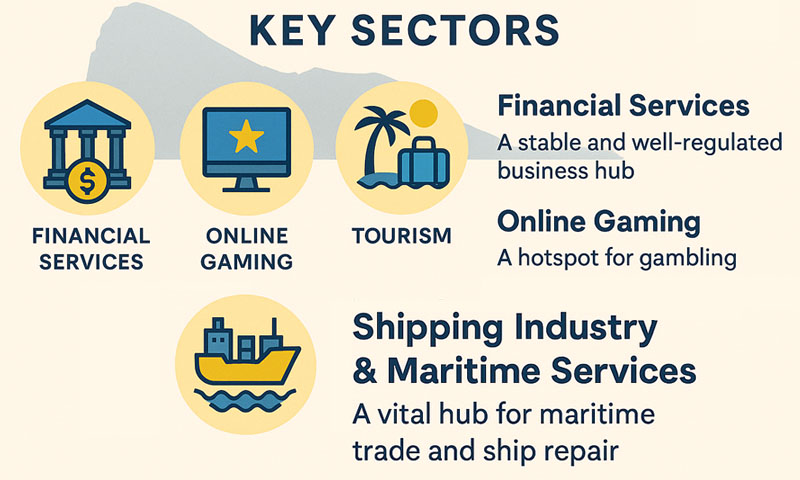
Key Sectors
Financial Services
Gibraltar has developed an established regulated financial services sector covering banking, insurance, investment services, pensions, professional services and financial technology.
Financial businesses are regulated by the Gibraltar Financial Services Commission (GFSC).
The jurisdiction also has a competitive tax environment. The standard corporate tax rate is currently 15%, having increased from 12.5% on 1 July 2024. Certain utility companies and businesses abusing a dominant market position are subject to a higher rate of 20%.
Gibraltar was also one of the earlier jurisdictions to establish a dedicated regulatory framework for businesses using Distributed Ledger Technology (DLT). The DLT framework came into operation in 2018, and authorised providers continue to be supervised by the GFSC.
Rather than operating as an unregulated offshore crypto centre, firms carrying out regulated DLT activities must meet Gibraltar’s authorisation and supervisory requirements.
Online Gaming
Online gaming remains one of Gibraltar’s most important economic sectors.
Government statements in late 2025 and 2026 put employment in the sector at approximately 3,400 people. The Gibraltar Government has also estimated that online betting and gaming contributes around 30% of GDP and approximately one-third of tax receipts when corporation tax, personal taxation, social insurance and gambling duties are considered together.
The regulatory framework also changed substantially in 2026.
The Gambling Act 2005 was replaced by the Gambling Act 2025, which largely came into force on 1 April 2026. The new legislation modernised Gibraltar’s licensing and supervisory framework, including provisions covering operators, B2B suppliers, key individuals, regulatory enforcement and consumer protection.
Gambling businesses operating in or from Gibraltar are overseen through the Gambling Division, the Gambling Commissioner and the relevant Licensing Authority.
The sector remains particularly important to Gibraltar’s relationship with the UK market, although changes to UK gambling taxation continue to create commercial pressures for operators based in the territory.
Tourism
Tourism remains an important part of Gibraltar’s economy, supporting attractions, hotels, restaurants, retail and transport services.
Visitor statistics need to be interpreted carefully because Gibraltar records different categories of arrivals rather than simply counting unique tourists.
In 2025, official statistics recorded approximately 9.26 million visitor arrivals through the land frontier. These figures include repeated movements and should therefore not be interpreted as 9.26 million individual tourists.
Cruise tourism also plays an important role. Gibraltar recorded 355,468 cruise passenger arrivals in 2025.
Its location, Mediterranean climate, cruise facilities and attractions including the Rock of Gibraltar, St Michael’s Cave, the Nature Reserve, Europa Point and the historic town centre continue to support the visitor economy.
Shipping Industry and Maritime Services
Located at the entrance to the Mediterranean and beside one of the world’s busiest maritime corridors, Gibraltar has long played an important role in shipping and maritime services.
According to the Gibraltar Port Authority, approximately 60,000 vessels transit the Strait of Gibraltar each year.
The port provides services including bunkering, ship agency, supplies, repairs and other maritime support services. Gibraltar Port Authority describes Gibraltar as the largest bunkering port in the Mediterranean.
Its geographical position between the Atlantic and Mediterranean remains one of Gibraltar’s major economic advantages.
Employment and Economic Output
Gibraltar generates a high level of economic activity relative to its population and land area.
The Government’s 2026 Budget forecasts GDP of approximately £3.253 billion. Based on an estimated resident population of 38,200, this corresponds to approximately £85,145 of GDP per capita.
Employment has also reached historically high levels. The latest Employment Survey recorded 32,206 employee jobs, while average annual earnings were reported at £39,511.
A significant proportion of Gibraltar’s workforce lives outside the territory, particularly in neighbouring Spain. The economic relationship with the surrounding Campo de Gibraltar region therefore remains particularly important.
The 2026 Gibraltar–EU Treaty and the Economy
One of the biggest changes to Gibraltar’s economic environment took place in July 2026.
The new UK–EU Agreement in respect of Gibraltar was signed on 14 July and entered into provisional application on 15 July 2026.
The treaty removed routine immigration and customs checks at the Gibraltar–Spain land frontier, improving the movement of frontier workers and creating a new framework for trade in goods.
It also established a customs union between Gibraltar and the European Union. Gibraltar has not joined the EU Customs Territory and remains outside the EU and Schengen, but goods moving between Gibraltar and the EU are now covered by a bespoke customs system.
The reforms also introduced new rules concerning Transaction Tax, excise duties, product standards and customs procedures. Gibraltar nevertheless remains outside the VAT system.
The treaty does not provide general free movement of services. Gibraltar-based financial, gaming and other service businesses therefore do not automatically gain unrestricted access to provide services throughout the European Union.
Gibraltar’s Economic Outlook
Gibraltar enters the second half of 2026 with an economy that remains highly specialised and closely connected to international markets.
Financial services, online gaming, tourism and maritime activities continue to provide much of its economic base, while technology, professional services, construction and property development also contribute to activity.
The implementation of the new Gibraltar–EU treaty has removed much of the uncertainty surrounding the land frontier and created a clearer framework for trade in goods and the movement of frontier workers.
At the same time, Gibraltar remains exposed to external developments, including changes in UK gambling taxation, international financial regulation and economic conditions in Britain, Spain and the wider European market.
Its long-term economic position will therefore depend on maintaining regulatory credibility, competitive industries, a fluid relationship with neighbouring Spain and strong economic links with the United Kingdom.
Last Updated on September 6, 2026 by Sebastien Frisco