
Gibraltar is well known for its competitive tax system and established regulatory framework, which have made the territory a base for businesses operating in sectors such as financial services, online gaming, insurance, technology and maritime services. This guide explores the key aspects of corporate taxation and the main requirements for companies operating in Gibraltar.
Pros and Cons of Running a Business in Gibraltar
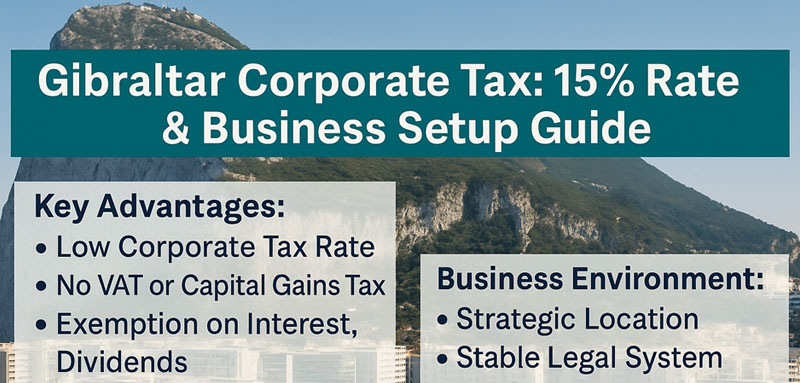
Gibraltar offers several advantages to businesses, particularly through its legal framework, specialist regulatory sectors and comparatively low corporate tax rate.
- The standard corporate tax rate is 15%. Certain utility companies and businesses enjoying and abusing a dominant market position are subject to a higher rate of 20%.
- There is no general capital gains tax in Gibraltar.
- Gibraltar remains outside the VAT system.
- Companies operate within a legal system based substantially on English common law, alongside Gibraltar legislation.
- Regulated sectors such as financial services and online gaming benefit from established local supervisory frameworks.
It is important, however, not to confuse Gibraltar’s absence of VAT with an absence of taxation on goods.
Since 15 July 2026, a new Transaction Tax has applied to goods as part of the customs arrangements introduced under the UK–EU Agreement in respect of Gibraltar. The standard rate is currently 15%, with reduced rates of 5% and 0% applying to certain categories of goods.
Unlike VAT, Transaction Tax is not a sales tax charged to the consumer at the point of sale. It is generally levied on the value of goods when they are imported or released onto the Gibraltar market. The tax applies to goods rather than services.
Beyond taxation, Gibraltar’s position at the entrance to the Mediterranean, its international airport, port infrastructure and English-speaking professional environment support businesses with international activities.
However, Gibraltar remains a small domestic market, with limited land and relatively high commercial property costs.
The situation following Brexit has also changed substantially. The new Gibraltar–EU treaty has reduced uncertainty surrounding the land frontier and created a customs union for goods, but it does not provide general free movement of services between Gibraltar and the European Union.
Businesses should therefore distinguish between Gibraltar’s improved access for the movement of goods and the separate rules governing the cross-border provision of services.
How Does Corporate Tax Work in Gibraltar?
Gibraltar companies are taxed under the Income Tax Act 2010.
The standard corporation tax rate is currently 15%, having increased from 12.5% on 1 July 2024.
Tax is generally charged on taxable profits or gains that accrue in or are derived from Gibraltar. The tax position of a company therefore depends on the nature and source of its activities and income, rather than simply on the fact that the company is incorporated in Gibraltar.
Companies incorporated under the Gibraltar Companies Act, or companies with assessable income in Gibraltar, are required to register with the Income Tax Office.
Certain companies, including utility businesses and companies enjoying and abusing a dominant market position, are taxed at 20%. Telecommunications activities are also subject to specific rules.
Because the source and taxation of corporate income can be complex, companies with international operations should obtain professional tax advice based on their actual business structure and activities.
Procedures and Requirements for Starting a Business in Gibraltar
Companies are incorporated through Companies House Gibraltar under the Companies Act 2014.
A Gibraltar company must comply with requirements concerning matters such as its registered office, directors, company officers, accounts and statutory filings.
Incorporating a company and obtaining permission to carry on business are separate processes.
Under the Fair Trading Act 2023, businesses carrying on commercial activities in Gibraltar generally need either a business licence or registration through the Office of Fair Trading (OFT), unless the activity is regulated separately or falls within a statutory exemption.
The OFT now operates a combined online Business Application covering business registration and licence applications.
Legal Requirements
Depending on the nature of the business, requirements may include:
- Incorporating the company and completing the relevant filings with Companies House Gibraltar.
- Registering the business or obtaining a business licence from the Office of Fair Trading when required.
- Registering with the Income Tax Office.
- Registering employees and complying with Gibraltar employment and social insurance requirements.
- Obtaining additional authorisation when operating in a regulated sector, such as financial services, gaming or certain professional activities.
- Complying with the new customs, Transaction Tax and excise rules when importing, exporting or trading in goods.
- Meeting applicable accounting, annual return, tax return and audit or reporting requirements.
- Complying with applicable anti-money laundering, beneficial ownership and data protection obligations.
Gibraltar’s New Customs and Transaction Tax System
One of the biggest changes for businesses in 2026 is the new customs framework introduced under the UK–EU Agreement in respect of Gibraltar.
The agreement establishes a customs union between Gibraltar and the European Union. Gibraltar has not joined the EU Customs Territory, but special rules now govern trade between the two territories.
For qualifying goods moving between Gibraltar and the EU, the framework removes customs duties and quantitative restrictions, subject to the detailed treaty rules and customs procedures.
Gibraltar’s traditional Import Duty system has been replaced for goods entering the local market by the new Transaction Tax and, for products such as tobacco, alcohol and fuel, relevant excise duties.
The standard Transaction Tax rate is 15% during the first year of the new system. The Government has indicated that it will rise to 16% in the second year and then to a rate no lower than the lowest standard VAT rate in the EU, currently 17%.
Reduced rates of 5% and 0% apply to specified categories of goods.
Businesses trading in goods should therefore consult current HM Customs guidance rather than relying on Gibraltar’s historic import-duty rules.
Does the Treaty Give Gibraltar Businesses Access to the EU Market?
The answer depends on whether the business deals in goods or services.
For goods, the 2026 treaty creates a customs union designed to facilitate trade between Gibraltar and the EU.
For services, the position is different.
The treaty does not establish free movement of services. A Gibraltar company does not automatically acquire the right to provide regulated or commercial services throughout the European Union simply because it is established in Gibraltar.
Similarly, businesses established in Spain or elsewhere in the EU do not automatically gain a right under the treaty to provide services in Gibraltar without complying with Gibraltar’s registration, tax and regulatory requirements.
This distinction is particularly important for financial services, professional services, technology and other service-based businesses.
Businesses That May Be Attracted to Gibraltar
Gibraltar’s economy is heavily focused on specialist service industries.
Important sectors include:
- Financial services, including insurance, banking, investment and professional services
- Online gaming
- Fintech and DLT-related businesses
- Maritime and shipping services
- Professional and corporate services
- Technology businesses
The benefits and tax treatment available to any company depend on how and where its activities are carried out. Gibraltar should therefore not be regarded simply as a jurisdiction in which incorporating a company automatically results in a 15% tax liability on all profits worldwide.
Support for Start-Ups and Small Businesses
Gibraltar operates programmes intended to support new and smaller businesses.
One example is the Gibraltar Enterprise Scheme, a government-backed financing programme available to qualifying start-ups and small businesses operating for less than three years.
Under the current scheme, successful applicants can obtain loans generally ranging from £10,000 to £25,000, provided through participating local banks and guaranteed by the Government of Gibraltar.
Applications have been accepted on a year-round basis since 2025.
Businesses should check current conditions before applying, as support schemes and eligibility criteria can change.
Is It Really Worth Setting Up a Company in Gibraltar?
Gibraltar can be attractive for some businesses because of its 15% standard corporate tax rate, specialist regulatory environment, English-speaking workforce and established professional services sector.
However, whether Gibraltar is suitable depends heavily on the nature of the business.
Companies should consider:
- where their income is actually generated;
- where their customers and employees are located;
- whether they require access to EU markets for goods or services;
- licensing and regulatory requirements;
- office and staffing costs;
- tax residency and substance requirements;
- the tax rules of other countries in which they operate.
A company should therefore analyse its business model and obtain appropriate legal and tax advice before deciding to establish operations in Gibraltar.
Long-Established Businesses in Gibraltar
Gibraltar has hosted international businesses for decades, particularly in online gaming, insurance and financial services.
The development of these industries has created a substantial local ecosystem of lawyers, accountants, compliance professionals, technology specialists and other professional services.
However, individual companies can relocate, restructure or change their presence over time. Anyone researching specific businesses should therefore check current regulatory registers and Companies House records rather than relying on historical lists of Gibraltar-based companies.
Is Gibraltar a Tax Haven?
The expression “tax haven” does not have a single universally accepted legal definition, so simply answering yes or no can be misleading.
Gibraltar is clearly a low-tax jurisdiction, with a standard corporate tax rate of 15% and no general capital gains tax. At the same time, it participates in international tax transparency, information exchange and anti-money laundering frameworks.
The OECD Global Forum rated Gibraltar “Largely Compliant” with the international standard for transparency and exchange of information on request in its most recent full peer review.
Gibraltar is also not included on the EU’s February 2026 list of non-cooperative jurisdictions for tax purposes.
In addition, the Financial Action Task Force (FATF) removed Gibraltar from its list of jurisdictions under increased monitoring in February 2024, after recognising progress in addressing previously identified anti-money laundering and counter-terrorist financing deficiencies.
For these reasons, a more accurate description is that Gibraltar is a low-tax international business and financial jurisdiction operating within international transparency and regulatory frameworks.
Do You Need to Be British to Open a Company in Gibraltar?
No. British nationality is not a general requirement for incorporating a company in Gibraltar.
However, incorporating a company is different from obtaining the right to work, reside or personally conduct business in Gibraltar.
Foreign owners and directors may therefore need to consider immigration, residency, employment, business licensing and tax requirements depending on their circumstances.
A Gibraltar registered office and the required corporate filings must also be maintained in accordance with the Companies Act.
Using qualified local corporate, legal and tax professionals can be particularly useful when the business has shareholders, directors, employees or activities in several countries.
Sources for More Information
For corporate taxation and business establishment, primary official sources should be checked whenever possible:
- Gibraltar Income Tax Office: Corporation tax, company registration for tax purposes and tax guidance. www.gibraltar.gov.gi/income-tax-office
- Companies House Gibraltar: Incorporation, company filings and company registry information. www.companieshouse.gi
- Office of Fair Trading: Business registration and licensing requirements. www.oft.gov.gi
- Gibraltar Financial Services Commission: Regulation of financial services and other activities within its remit. www.fsc.gi
- HM Government of Gibraltar: Current information concerning the 2026 Gibraltar–EU treaty, customs and Transaction Tax. www.gibraltar.gov.gi
- Gibraltar Chamber of Commerce: Business information, representation and networking. www.gibraltarchamberofcommerce.com
Conclusion
Gibraltar combines a 15% standard corporate tax rate, specialist regulatory sectors and an established legal and professional services environment.
The business landscape nevertheless changed significantly in 2026. Gibraltar remains outside the EU and VAT system, but the new Gibraltar–EU treaty has introduced a customs union, Transaction Tax and new rules for the movement of goods.
At the same time, the treaty does not restore general free movement of services between Gibraltar and the EU.
For businesses considering Gibraltar, the key question is therefore not simply whether its headline corporate tax rate is attractive. Companies need to examine where their profits arise, what licences they require, where they trade and employ staff, and how Gibraltar’s rules interact with those of other jurisdictions.
Professional advice is particularly important for international structures, regulated businesses and companies trading across borders.
Last Updated on September 3, 2026 by Sebastien Frisco